Calculating arrival date




Printed Books vs eBooks Statistics, Trends and Facts [2026]
Posted by Rob Errera on 03/30/2026
At a Glance: Books vs. eBooks
- The physical book market is projected to reach $70.75 billion by 2029, significantly higher than the eBook market, which is expected to reach $15.87 billion by 2030.
- In terms of audience, print books are projected to reach around 1.9 billion readers by 2029, compared to 1.18 billion eBook users worldwide by 2030.
- In the United States, print remains the most popular format, with 46% of adults reading physical books in 2025, compared to 24% for eBooks and 23% for audiobooks.
- Digital readers tend to consume more content overall, with 13% reading over 50 books per year, compared to just 4% of print readers.
- Amazon's Kindle currently dominates the e-reader market, holding a substantial 72% share.
- On Amazon, new hardcover bestsellers in 2026 cost an average of $20.42, while eBooks cost $12.99, making eBooks about $7.43 cheaper.
Print and digital reading continue to grow side by side, with each format holding a strong place among readers. Recent statistics show that printed books still attract a large audience, even as eBooks steadily increase in popularity.
Preferences often depend on convenience, price, and reading habits rather than one format replacing the other.
Here’s a clear look at the latest eBook vs. print book data, key differences, and current industry direction.
Popularity Contest: eBooks vs. Print Books
Are print books still popular? You’d better believe it!
According to the YouGov survey (2025) on reading habits and formats, physical books remain the most commonly used format, even as digital and audio continue to grow.
Survey says:
- 46% of Americans read at least one physical book
- 24% read at least one digital book
- 23% listened to at least one audiobook
- 29% used more than one format
- 23% read only physical books
- 5% preferred only digital books
- 2% listened to audiobooks only
Reading Volume by Format in the US (2025)
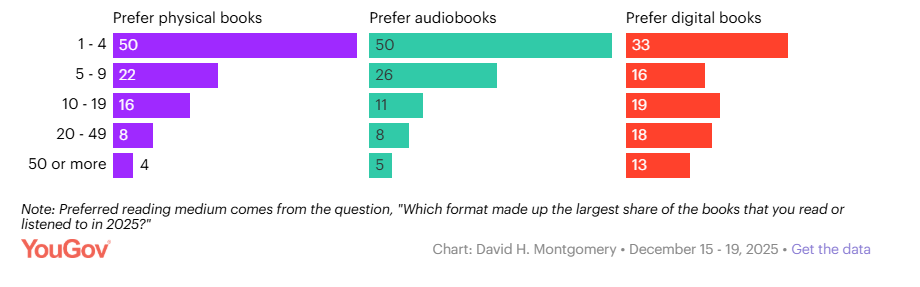
The same survey showed that people who preferred digital formats tended to read more books overall compared to those who preferred print or audiobooks.
Among digital readers:
- 33% read 1–4 books
- 16% read 5–9 books
- 19% read 10–19 books
- 18% read 20–49 books
- 13% read 50+ books
Among print readers:
- 50% read 1–4 books
- 22% read 5–9 books
- 16% read 10–19 books
- 8% read 20–49 books
- 4% read 50+ books
This shows that while print remained the most widely used format, digital readers were more likely to reach higher reading volumes.
eBooks vs Printed Books Sales
- Print books out-sell eBooks 4 to 1
- Printed book sales in the US reached approximately 762.4 million units in 2025, showing a slight increase of 0.3% compared to 2024. Although sales have declined from the 2021 peak of 839.7 million units, they remain higher than pre-pandemic levels.
- This follows strong growth between 2020 and 2021, when print sales increased by 13.2% year-over-year and 21% compared to 2019. Since then, the market has stabilized with smaller annual changes.
- Looking at categories, adult fiction continued to grow, rising by 1% in 2025. Within the category, romance sales increased by 3.9% to nearly 44 million units, while fantasy declined by 8.7% to 24.1 million units.
- On the digital side, 191 million eBooks were sold in the US in 2020, with sales increasing by 22% that year.
- This was followed by a decline of 8% in 2021, though sales remained above 2019 levels.
- In September 2025, eBook revenues in the US declined by 7.9% compared to the same month in 2024, reaching $85.4 million.
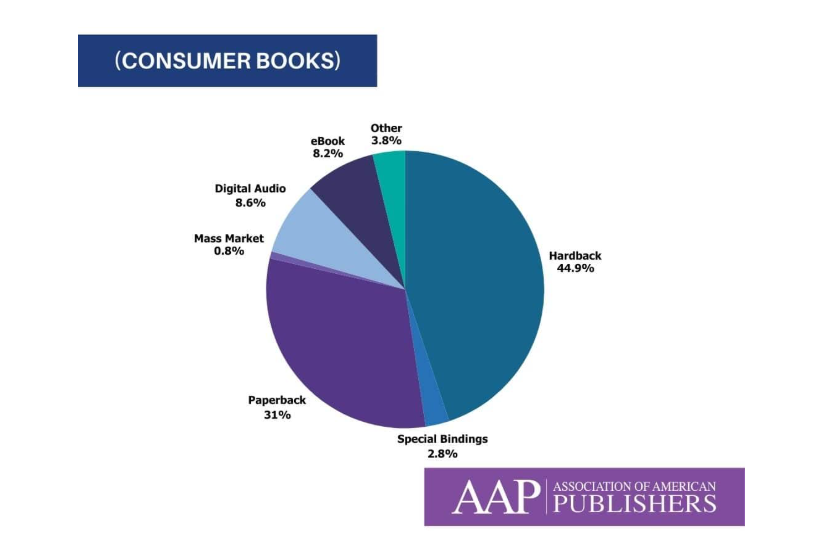
Percentage of Total Trade Sales During September 2025 (by Format)
Kindle vs Book Statistics
By far, the most popular e-reader on the market is Amazon’s Kindle.
The Kindle comes in a variety of formats, such as color and glare-free displays, and all use the AZW eBook format.
Most other e-readers, like Barnes & Noble Nook and Apple Books, use the more widely supported EPUB format for eBooks.
- 72% of the e-reader market belongs to Amazon Kindle
- 10% of the e-reader market belongs to Barnes & Noble Nook
- 18% of e-readers use an alternative app for digital reading
The global Kindle market was valued at around $18 billion in 2025 and is expected to reach $24.99 billion by 2035, showing steady long-term growth.
At the same time, about 42% of readers still prefer printed books, which continues to limit wider adoption of e-readers.
Amazon also leads the eBook market in the US, accounting for the majority of digital book purchases. Barnes & Noble and eBooks.com remain among the key marketplaces, though they hold significantly smaller shares.
A more recent study from Pew Research suggests more people are reading on their smartphones and tablets, leading to a recent decrease in e-reader sales.
A 2012 report from NewZoo found 17.4 million active Kindle Fire users and 30.5 million iPad users in the United States. By 2018, Amazon reported selling close to 90 million e-readers.
Check also ➜ How Many Books Are Published Each Year?
Publishing Revenue and Market Trends
Publishing market research shows the economic strength of traditional books. While publishers are experimenting with different formats, especially audiobooks, they continue to invest heavily in physical book sales.
The revenue of the physical book market is expected to grow at a CAGR of 0.37% from 2024 to 2029, reaching $70.75 billion by 2029. This reflects a projected 1.9 billion users, with an average revenue of $37.95 per user.
Looking at past performance, the US book publishing industry reached its highest-ever revenue of $29.33 billion in 2021, marking a 12.3% increase compared to 2020.
In terms of format share, physical books accounted for over 75.5% of total revenue for trade publishers. In contrast, eBooks declined by 5.0% compared to 2020, totaling $1.97 billion and making up 10.5% of total revenue.
Recent monthly data reflect similar patterns in the industry.
In October 2025, total publishing revenue in the US reached $1.5 billion, up 6.7% year over year, while eBook revenues increased slightly by 1.9% to $88.3 million, according to the Association of American Publishers.
Canada Book Market Mirrors The US
Canadian booksellers see the same trends as the United States: people prefer print when it comes to long-form reading.
A 2024 survey from the Canadian Book Consumer Study supports these findings:
- Most Canadian book buyers preferred print books (70%), followed by eBooks (17%) and audiobooks (8%).
- Print books made up 75% of purchases by Canadian buyers in the latest survey.
- E-books accounted for 15% of purchases
- Audiobooks made up 6% of purchases
The Distribution of Book Purchases by Format in Canada (From 2019 to 2024)
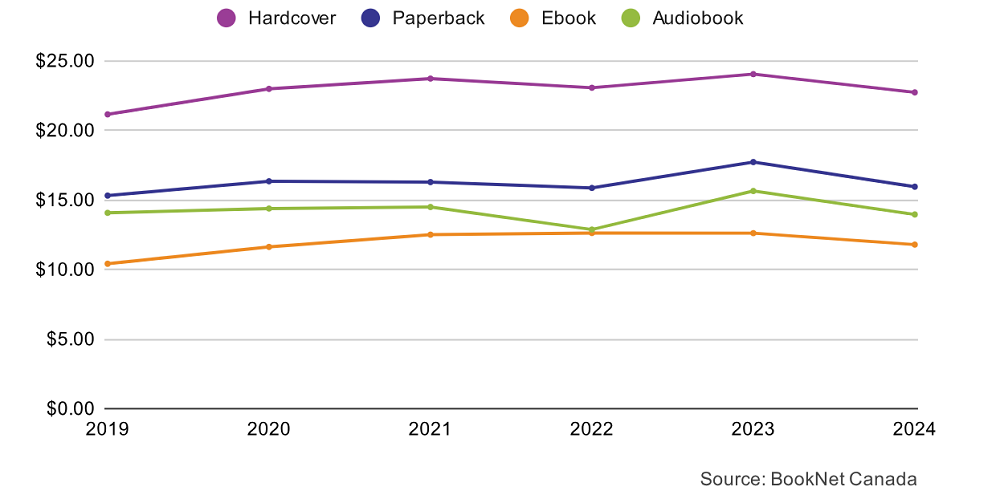
- Among book buyers, those aged 65+ accounted for the largest share of book purchases at 20%
And this trend is not just confined to Canada or North America. The same thing happens in a dozen different countries.
Reader vs. E-Reader Statistics: Educational Levels
Reading habits vary by education level, with higher-educated individuals generally reading more books.
Among US adults, the average number of books read is 8 per year, and this number increases with education.
Those with a college degree read an average of 10.6 books, while individuals with a postgraduate degree read around 13.6 books.
In comparison, those with a high school education or less read about 4.6 books on average.
Education also influences reading preferences. Readers with college degrees are more likely to choose genres such as literary fiction, academic, and historical books, while differences are smaller for genres like graphic novels and romance.
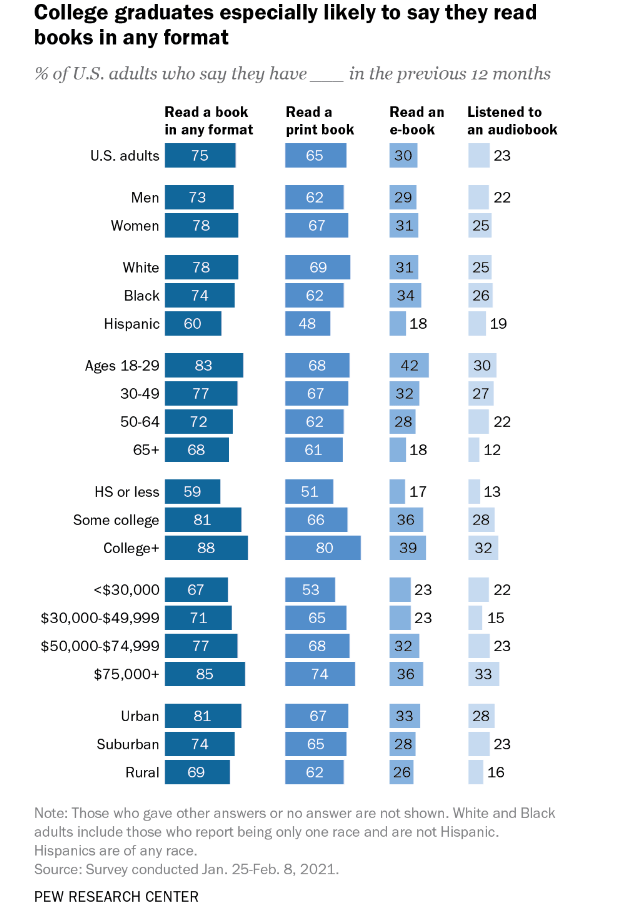
Earlier research from Pew Research (2021) shows a similar pattern, with college graduates more likely to read books than those with lower education levels.
College graduates:
- 88% read a book last year
- 80% read a print book
- 39% read an e-book
- 32% listened to an audiobook
High school (or less) graduates:
- 59% read a book last year
- 51% read a print book
- 17% read an e-book
- 13% listened to an audiobook
Reading Habits Reported by Various Groups in the US
Reader vs. E-Reader Statistics: Income Levels
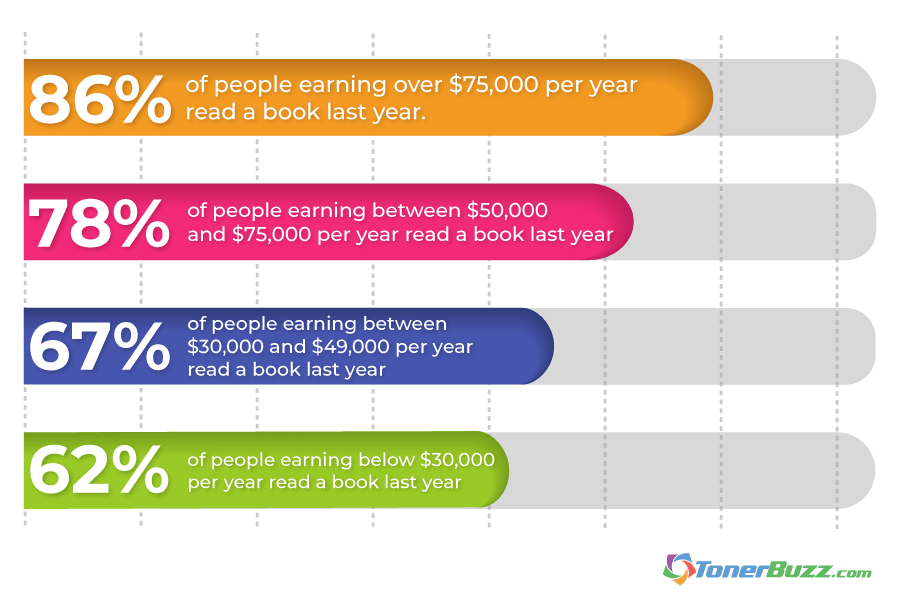
- 86% of people earning over $75,000 per year read a book last year.
- 78% of people earning between $50,000 and $75,000 per year read a book last year.
- 67% of people earning between $30,000 and $49,000 per year read a book last year.
- 62% of people earning below $30,000 per year read a book last year.
eBooks vs Print Books: Costs & Savings
In the early days of eBook publishing, the digital versions of books were priced much cheaper than the print versions.
This made sense.
There were no printing, paper, or shipping costs involved, so a digital book should naturally cost less. A decade ago, it was not uncommon to see a hardcover bestseller priced at $25 with a digital edition price around half that.
Today, the prices of physical books are much closer, especially when it comes to new releases and popular authors.
The real savings of eBooks come with older works and backlist titles. The digital editions of books that have been available for a while have dropped significantly. You can get eBook editions of classic literature for very cheap (even free).
Independent authors also offer up a wide variety of eBooks that are priced less than books from traditional publishers.
There are bargain books in both the physical and digital realms. You can find plenty of one-dollar eBooks online, enough to max out your e-reader. You can also find a table filled with $5 hardcovers at the local warehouse store.
Overall, eBooks will save avid readers money, but not as much as you’d expect.
eBook vs Print Book Costs in 2026
Amazon Bestseller list 02/12/26:
- Allen Levi's “Theo of Golden” is $27.52 hardcover and $11.99 eBook - $15.53 difference in favor of the eBook.
- Mel Robbins and Sawyer Robbins’ “The Let Them Theory” is $6.75 hardcover and $17.99 eBook - $11.24 difference in favor of the hardcover.
- Andy Weir’s “Project Hail Mary” is $22.69 hardcover and $14.99 eBook - $7.7 difference in favor of the eBook.
- Virginia Evans’s “The Correspondent” is $19.58 hardcover and $13.99 eBook - $5.53 difference in favor of the eBook.
- Freida McFadden's “The Housemaid” is $29.18 hardcover and $6.99 eBook - $22.19 difference in favor of the eBook
- Amelia Hepworth’s “I Love You to the Moon and Back" is $16.81 hardcover and $7.99 eBook - $8.82 difference in favor of the eBook.
New hardcover bestsellers in 2026 sell for an average price of $20.42, while their eBook counterparts are priced at around $12.99.
This means the price difference is around $7.43, so eBooks are generally more affordable than hardcover editions.
eBook vs Print Book Costs in 2021
To compare, let's look at the same data from 2021.
The difference in price between eBooks and paper books was less back in 2021, with some Kindle versions selling at a higher price than hardcover:
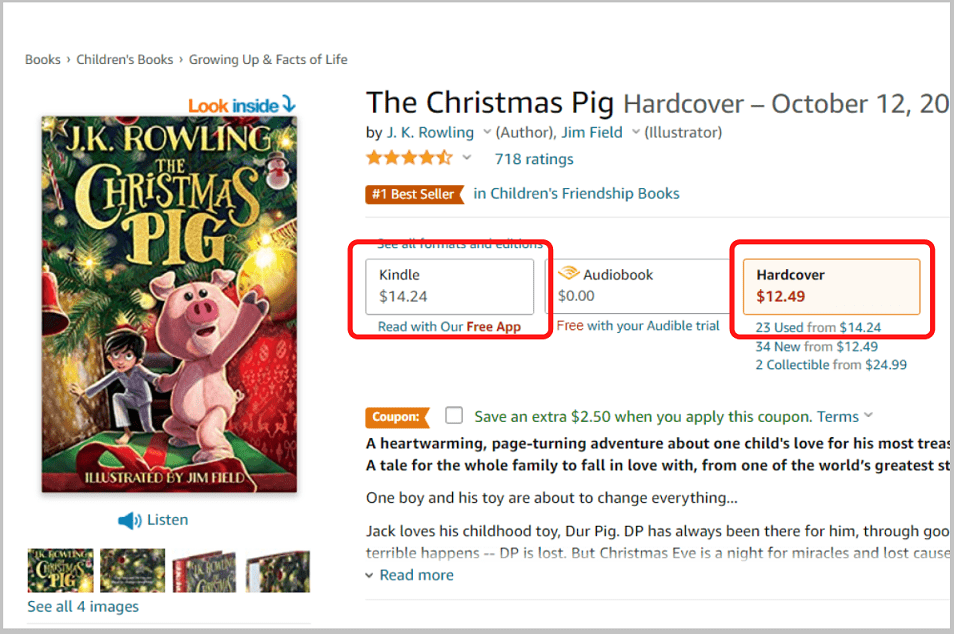
eBook offered at a higher price than Hardcover on Amazon
Amazon Bestseller list 10/12/21:
- JK Rowlings’s “The Christmas Pig” is $12.49 hardcover and $14.24 eBook - 1.75$ difference in favor of the the Hardcover
- Adam Schiff’s “Midnight in Washington” is $25.49 hardcover and 14.99 eBook - $10.50 difference
- Dave Grohl’s “The Storyteller” is $19.49 hardcover and $14.99 eBook - $4.50 difference
- Ron and Clint Howard’s “The Boys” is $20.49 hardcover and $14.99 eBook - $5.50 difference
- Nicholas Sparks “The Wish” is $15.99 hardcover and $14.99 eBook - $1.00 difference
- Anthony Doerr’s “Cloud Cuckoo Land” is $18.57 hardcover and $14.99 eBook - $3.58 difference
Based on the numbers above, new hardcover bestsellers sold for an average price of $19.30 in 2021, while their eBook counterparts sold for around $15, meaning eBooks were cheaper by about $4 per title.
By 2026, this gap has increased to approximately $7.43, showing that eBooks have become more affordable compared to hardcover editions over time.
Don’t Forget Your Local Library
You can’t get cheaper than free. Public libraries across the country allow you to borrow print and digital editions of books for a select period of time, usually a week or two.
As long as you return your borrowed books on time and in good condition, the local library offers a lifetime of free reading
Plus, libraries are one of the biggest buyers of books. Let them make the investment while you reap the reading rewards!
Can You Save Money by Printing Free eBooks?
In addition to purchasing books, readers can often find free eBooks in PDF or other formats online. Websites like Project Gutenberg and Open Library offer thousands of public domain and older works at no cost.
Some contemporary authors also make their works available for free download during promotions or on personal platforms.
But while downloading these eBooks is free, printing them at home comes with its own costs. Let's look at an example:
Example: Printing Jane Austen’s Pride and Prejudice
- Number of Pages: 538
- Sheets of Paper Needed: 269 (double-sided printing)
- Paper Cost: At $0.01 per sheet, the total paper cost is $2.69.
Toner Costs:
Let’s look at some example toner cartridges to see the results with different options:
- Using an HP 414X High-Yield Toner Cartridge Set ($895, 7,500-page yield), the per-page toner cost is $0.12. Printing 538 pages would cost $64.56.
- Alternatively, with an HP 414A Standard-Yield Toner Cartridge Set ($539, 2,400-page yield), the per-page toner cost is $0.22, resulting in $118.36 for 538 pages.
- With an HP 206X High-Yield Toner Cartridge Set ($529, 3,150-page yield), the per-page toner cost is $0.17, resulting in $91.46 for 538 pages.
You can calculate the costs for any toner cartridge using our Printing Costs Calculator.
Total Cost of Printing:
- Using 414X toner: $2.69 (paper) + $64.56 (toner) = $67.25
- Using 414A toner: $2.69 (paper) + $118.36 (toner) = $121.05
- Using 206X toner: $2.69 (paper) + $91.46 (toner) = $94.15
In comparison:
- Buying the hardcover edition might cost $10–20.
- Buying the eBook version might cost as little as $1–10.
Printing the entire book yourself, even if the eBook was free, can cost between 3 and 12 times more than purchasing a hardcover or eBook, depending on the option you choose.
When Does Printing Make Sense?
Printing free eBooks might still be a good option in cases where:
- The book is unavailable for purchase (out-of-print or rare).
- You only need to print specific chapters or excerpts.
- You have access to significantly cheaper printing options, like workplace printers or bulk deals on toner and paper.
- You prefer a physical copy for note-taking, highlighting, or archiving purposes.
For most readers, though, printing full-length books at home is not a cost-saving alternative. Buying an eBook or borrowing from the library is typically far more economical and convenient.
The Benefits of E-Books
A book isn’t paper and binding. It is the words and ideas contained between the covers.
An e-book contains all of the words and information of a print edition with a number of additional benefits:
- The key difference between e-books and printed books is the lack of a physical object.
- For starters, one difference is that an e-book is more portable than a print book.
- You can store an entire library of e-books on your phone or tablet and not take up an inch of physical shelf space. Kindle libraries can be vast and contain appropriate content for people of any age.
- E-books take up very little data. Even if your data is limited, a dozen full-length editions will occupy no more than a megabyte of disk space. It’s hard for print to compete in this area of books vs. e-books. Physical books take up a lot of physical space.
- E-books do not have a fixed font size. Make those letters big and easy to read before bed. Or change the color of the type or the background. The options are endless and the convenience is outstanding.
- Adopting e-book technology can make you more well-read. Your Kindle will survey your e-book reading tastes and report suggestions based on titles with a related association.
- In addition, e-books have the benefit of a built-in dictionary. No more guessing at word meanings based on their context. You could look up word definitions on the fly. Even search the web to get deeper details about the eBook you’re reading.
- E-books also offer an excellent way to take notes regarding the text you are reading. Digital notes can be exported into any text editor, and you’re halfway through your book report or online review!
- Like all digital files, eBooks are also very convenient for sharing. Reader-community apps, like Goodreads, allow you to share your reading progress with others, almost like a built-in book club you can join or occasionally check in on.
- E-books are also easier on the environment. Gone is the association with stinky paper mills and unnecessary tree slaughter. No glue, no expensive ink. Unlike paper books, eBooks leave little to no carbon footprint.
The Benefits of Print Books
A print book is a joy to behold!
The smell of freshly printed pages, the smooth, silky feel of paper beneath your fingertips, the crinkle, and crackle of a story flowing by.
Print offers a unique reading experience.
Digital e-readers don’t engage the senses the way a physical book does. Reading a printed book is a tactile experience.
You feel it, you smell it, and you remember it.
This is one reason physical books are the more popular format for readers. Printed books touch readers on a more primal emotional level.
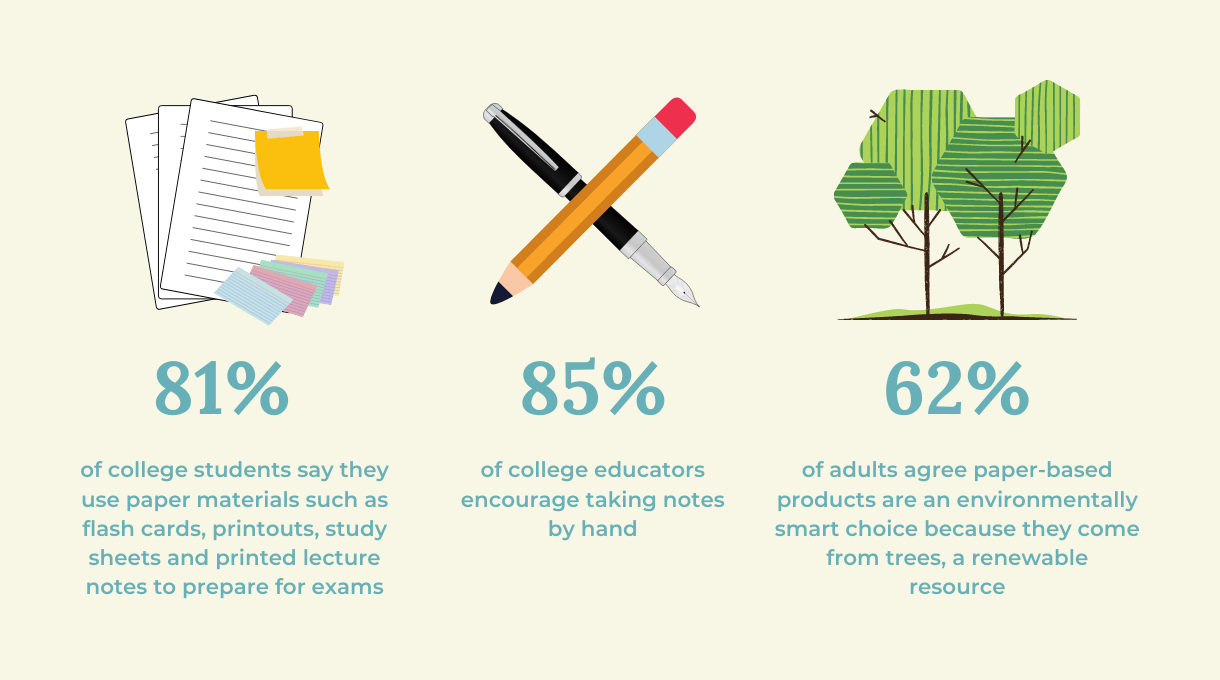
Physical Books vs eBooks Statistics Showing Why Traditional Books Are Better
- 66% of readers believe printed books offer a more unique and fulfilling reading experience than e-books.
- A majority of college students say they retain information longer when it is read in a printed format.
- Traditional books don’t cause the eye strain inherent to e-readers. Reading on an e-reader before bed disrupts sleep and impacts overall health
- Children learn better with paper books. Almost 90% of teachers and parents believe reading 15 pages on paper every day improves a child’s memory and language development.
- 64% of employees say they prefer paper agendas and memos to digital communication.
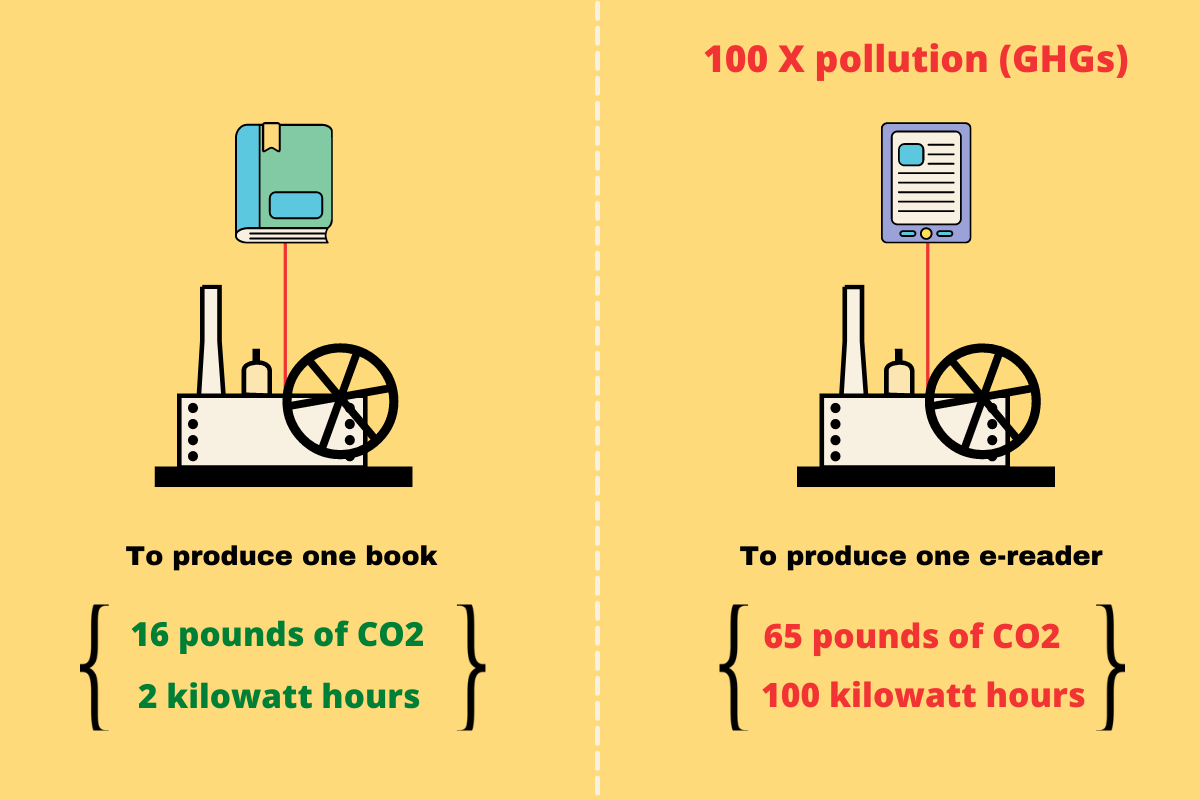
- E-readers take more carbon to produce than physical books.
- Discarded e-readers lead to toxic electronic waste. Old books can be recycled with other paper products.
Digital books bought online generally cost less. While a new hardcover can cost $30, the same book may only cost $15 on a Kindle e-reader. And that’s the top price for an eBook.
Most back titles are available for under five dollars. If you have limited income, e-readers and e-books are a better bargain when it comes to price.
In addition, reading a print book offers an uninterrupted “low tech” reading experience. E-readers and online reading in digital formats run the risk of pop-up ads, dying batteries, and power failures.
Despite its distribution limitations, print still reaches a broad demographic, especially among older readers.
For example, 41% of Americans over age 65 are not Internet users. The number of e-reader owners is even lower among this demographic.
The Future Of Printed Books
The statistics and surveys tell the story; despite the growing popularity of e-books, traditional publishing is here to stay.
The publishing industry uses market research to determine which book format a reader will prefer. U.S. libraries also contribute valuable data and figures on reader habits.
Another factor keeping traditional book publishing alive and well is the modern school system.
Textbook publishers have yet to embrace digital media. Heavy — and expensive — textbooks are still the norm for students. College students (and school boards) must buy the same textbooks year after year. Hey, the bulk of the information inside these textbooks hasn’t changed for centuries. Shouldn’t knowledge be free online somewhere?
Even though all the educational tools needed for academic success can be included on a lightweight laptop or tablet, print textbooks remain an essential part of classrooms.
This one of the main reasons readers prefer printed books over e-books — they were raised with print books all through school and they carry that love of physical books into adulthood.
The Future Of The eBook and E-Reader
A 2019 survey by Pew Research provides data and figures that publishers use to understand which reading formats are most popular. While eBooks and e-readers were not the “print killers” some predicted, digital books have continued to grow steadily.
The best-selling eBooks remain genre fiction, including romance, crime, science fiction, and thrillers.
The popularity of digital reading is expected to continue rising, supported by mobile usage and wider access to online platforms.
- The global eBook market is projected to reach $15.87 billion by 2030
- The number of eBook users is expected to reach 1.18 billion by 2030
- User penetration is projected to rise to 14.59% by 2030
Some broader estimates suggest faster long-term growth, with the global eBook market projected to exceed $207 billion by 2034.
While eBook revenue continues to grow, the adoption of dedicated eReaders is increasing more slowly, as many readers prefer smartphones and tablets.
People Still Read Books... And Always Will
From a social media post to a blog article, people today read short-form writing on smartphones and tablets. But when they want to read in longer formats, they turn to books, and, more often than not, they turn to “dead tree” editions printed with paper and ink.
Print books remain widely used, even as digital formats continue to grow. Rather than disappearing, they have adapted alongside eBooks and audiobooks, giving readers more flexibility in how they consume content.
Technology has expanded access to books, making it easier to discover, download, or listen to content at any time.
At the same time, physical books continue to offer a different kind of experience, especially for certain types of content.
Print is still commonly preferred for formats like:
- children’s books
- cookbooks
- workbooks and activity books
These formats often rely on visuals, interaction, or shared reading experiences that are harder to replicate digitally.
Overall, reading habits have expanded rather than shifted entirely. People now choose formats based on what suits them best, which keeps books relevant across all formats.
Sources
NDP
Paper and Packaging Board’s Fourth Annual Back-to-School Report: Paper and Productive Learning
The New York Times
Olympic College
https://yougov.com/en-us/articles/53804-most-americans-didnt-read-many-books-in-2025
hms.harvard.edu/news/e-readers-foil-good-nights-sleep
pewresearch.org/short-reads/2022/01/06/three-in-ten-americans-now-read-e-books/
pewresearch.org/internet/2015/10/29/the-demographics-of-device-ownership/
pewresearch.org/fact-tank/2019/09/25/one-in-five-americans-now-listen-to-audiobooks/
pewresearch.org/internet/2014/04/03/older-adults-and-technology-use/
pewresearch.org/short-reads/2022/01/06/three-in-ten-americans-now-read-e-books/
https://www.publishersweekly.com/pw/by-topic/industry-news/financial-reporting/article/99417-print-book-sales-rose-slightly-in-2025.html
publishers.org/news/aap-statshot-annual-report-book-publishing-revenues-up-slightly-to-25-93-billion-in-2019/
https://publishers.org/news/aap-september-2024-statshot-report-overall-publishing-industry-up-2-4-for-month-of-september-and-up-7-0-year-to-date/
https://publishers.org/news/aap-september-2025-statshot-report-overall-publishing-industry-up-14-4-for-month-of-september-and-down-0-4-year-to-date/
thestar.com/business/opinion/2020/01/27/print-still-rules-when-it-comes-to-books-in-ontario.html
voxburner.com/blog-source/2015/5/18/16-24-prefer-books-as-physical-products
newzoo.com/wp-content/uploads/2011/06/PRESSRELEASE_2012_Kindle_Newzoo_15042012_V4.pdf
publishingperspectives.com/2022/11/aap-six-charts-on-the-us-book-market-2017-to-2021/
https://www.statista.com/statistics/422595/print-book-sales-usa/
statista.com/outlook/dmo/digital-media/epublishing/ebooks/worldwide
statista.com/outlook/amo/media/books/physical-books/worldwide
https://www.statista.com/outlook/amo/media/books/physical-books/worldwide
statista.com/outlook/amo/media/books/physical-books/worldwide
https://www.statista.com/outlook/amo/media/books/ebooks/worldwide
https://www.statista.com/forecasts/997178/ebook-purchases-by-store-brand-in-the-us
https://www.amazon.com/gp/bestsellers/2021/books/ref=zg_bsar_cal_ye
https://www.amazon.com/gp/bestsellers/2026/books/ref=zg_bsar_cal_ye
https://static1.squarespace.com/static/550334cbe4b0e08b6885e88f/t/6650adc50c110735856c22c0/1716563398610/CBC_2023.pdf
https://www.businessresearchinsights.com/market-reports/amazon-kindle-market-120402
https://www.booknetcanada.ca/canadian-book-consumer-2024
https://www.fortunebusinessinsights.com/ebook-market-111315
https://techcrunch.com/2010/08/06/physical-book-dead/

Rob Errera
Rob Errera is an award-winning journalist embedded in the world of printers and printing supplies. Rob has nearly two decades of experience writing about cutting edge technology, business trends, and the ever-evolving industry of printing.